Wildlife


The Burren region is internationally famous for its landscape and flora. A visit to the Burren during the summer months will leave a person amazed by the colourful diversity of

Photo of The Blackhead

flowering plants living together within the one ecosystem. Arctic-alpine plants living side by side with Mediterranean plants, calcicole (lime loving) and calcifuge (acid loving) plants growing adjacent to one another and woodland plants growing out in the open with not a tree nearby to provide shade from the sun. Also found here are certain species which although rare elsewhere are abundant in the Burren. Even more amazingly they all survive in a land that appears to be composed entirely of rock.

Photo of A Meadow

We must not forget the enormous influence of the farming community in the region, through their farming techniques they have managed the land in such a way as to preserve the unusual flora and habitats that remain today. Not only have these habitats been preserved by the method of management in the region, they have been enhanced and owe their existence to the farming community.

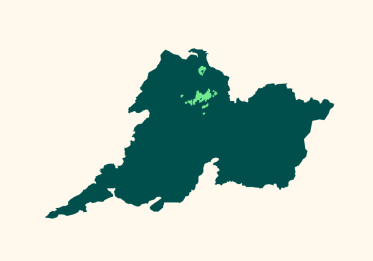
The Burren covers 1% of the land surface of Ireland and is approximately 250 square kilometres in size. Most of the Burren is designated a Special Area of Conservation to protect this extremely unusual habitat.

Habitats

A quick glance at the Burren would leave you thinking it was just rock and little else. This however, is a very complex ecosystem. The habitats within the Park grade into one another, and often are inseparable, creating a mosaic of habitats that are hard to isolate. For example limestone pavement is often inter mixed with calcareous grassland and hazel scrub, or ash woodland on limestone pavement. All the major Burren habitats are represented within the park. Approximately 75% of plant species found in Ireland are represented within the habitats of the Burren. Included among these are 23 of Irelands 27 native orchid species.

Photo Orchid Grassland

Limestone pavement

Limestone pavement has become almost synonymous with the Burren and covers most of the National Park, although, as mentioned above, usually in a mosaic with other habitats. The pavement may be of either a smooth or shattered type.

The smooth limestone pavement areas consist of clints and grykes. The clints are the slab like flat surface areas of the pavement and the grykes are the fissured cracks that dissect the clints. The grykes provide shelter for the soil to accumulate and also shelter from the wind. The thin soils that accumulate in the grykes provide just enough anchorage and nutrients to host a large diversity of plant species. Within the grykes you can find shade tolerant plants such as ivy and hearts tongue fern also a variety of other species such as Bloody Cranes-bill, Wall Lettuce, Wall-rue and Rue-leaved Saxifrage to name just a few. Also found eaking out an existence in the grykes are woody plants such as, Ash, Blackthorn, Holly, Buckthorn and Whitethorn. These are stunted like a bonsai due to the lack of space for the roots and also due to a lack of nutrients, water and soil. The wind, along with grazing, also plays a part in keeping these plants and trees at a low level, searching out shelter at ground level.

Photo of Keelhill

The clints are pitted with solutional hollows and runnels that provide enough shelter and water for mosses and algaes to survive. A blue-green alga known as Nostoc can be found in these pools. Nostoc absorbs water forming gelatinous algae. However when the pools dry up it drys out to form a paper like substance. Nostoc secretes an enzyme into the pools which increases the acidity of the water therefore increasing the erosion within the pools.

Photo of Fungi

On the shattered limestone, grykes are less frequent and plant life therefore is sparse, however if you look close many species thrive in these conditions. Burnet Rose, Wood Sage, Dark Red Helleborine, Hazel, Juniper, Yew and Blackthorn are all making this habitat their own. Again wind, soil and water are all limiting factors in their growth. Goats especially, also graze yew and Ash. Another anomaly of these pavement areas is the ability of woodland plants like Wood Sage to thrive out in the open without any shade.

Calcareous grassland

Calcareous grassland is found on the terraces of the mountains where there is a thin layer of soil, between the limestone pavement where there is also a thin layer of soil and on glacial deposits throughout the Burren. These calcareous grasslands host an extraordinary composition of flora. It is the calcareous grasslands, found in a mosaic with limestone pavement, which attract botanists from all over the world because nowhere else in the world is this precise mixture of plants found growing together.

It is not so much the rarity of the species found in these habitats, as the unusual and unique mixture of species. Arctic-Alpine plants are found growing side by side with Mediterranean plants, and at latitudes and altitudes not expected. For example, Mountain Avens and Spring Gentians, these are Arctic-Alpine plants normally found either in Arctic regions or high up in the Alps. In the Burren they are found growing from sea level up to the highest peak of 317metres. Many Mediterranean species like the Dense Flowered Orchid and Maidenhair Fern are found co-existing with the arctic-Alpine plants in this habitat. Lime loving plants (calcicole) and acid loving plants (calcifuge) also grow side by side. For example Heather, Lousewort and Tormentil grow interspersed amongst orchids, Bloody Crane’s-bill and Cowslips.

Hazel Scrub

This is a common habitat within the Burren. It occurs anywhere there is enough soil and shelter, large tracts of the southern Burren are completely blanketed with hazel scrub. The height of the scrub varies from knee height to 5 meters. The hazel provides shelter for many species of fauna, Badgers, Pine marten, Foxes, squirrels, mice, shrews, etc. and also for plant species such as Blackthorn, Whitethorne, Brambles, and tree species such as Ash, Holly and Willow. Scrub represents a stage in the succession to woodland, such as Ash, Pine or Oak woodland.

Photo of Bloody Cranes Bill

In spring and summer the hazel canopy allows enough light in to support the development of a rich ground flora. These woodlands in early spring are carpeted with Bluebells, Wild Garlic, and Wood Anemone. Later in the summer Helleborines and other typical woodland flora are abundant.

The Hazel scrub provides extensive suitable habitat for many different fungi and lichens, some of which are extremely rare. These rare species, combined with other more common fungi, create an extremely diverse community of micro-organisms: amongst the most important in the British Isles.

Deciduous woodland

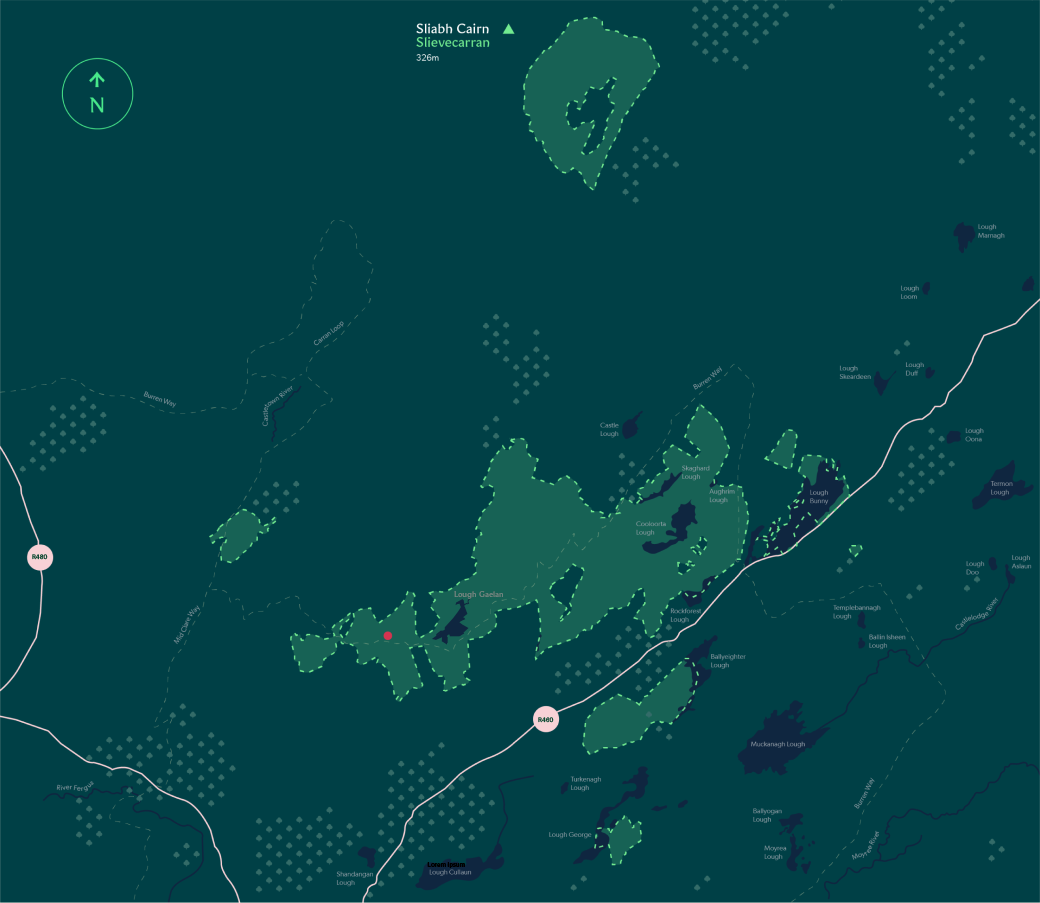
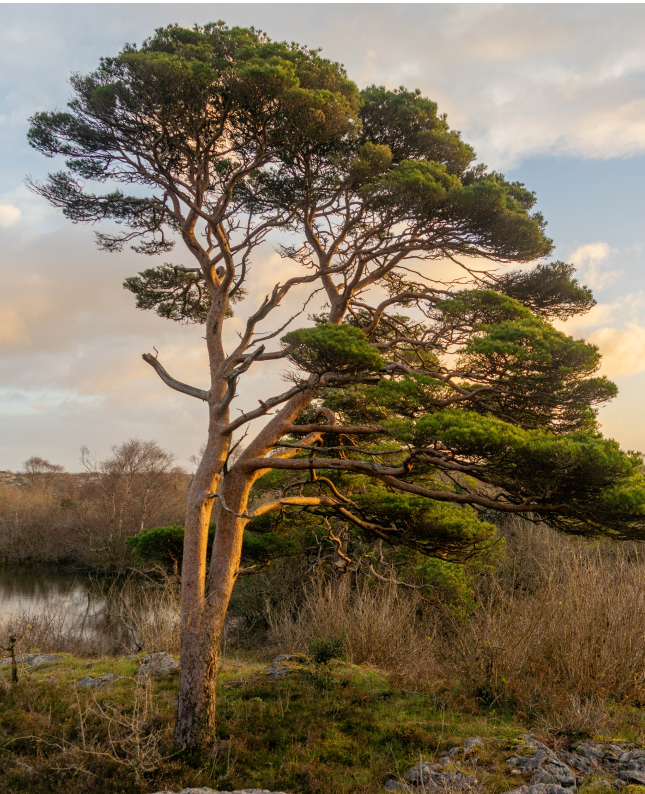
Mature deciduous woodland is not common within the Park, but there are some very good examples of Ash/Hazel woodland, Pine Forest and Oak/Ash Woodland. Scrub will turn to mature deciduous woodland with time, given adequate depth of soil and shelter. These woodlands tend to be found in dry valleys that have steep sides where the wind sweeps across the top, or in the shelter of cliffs. To the south east of Mullaghmór is an excellent example of Scots Pine woodland and close by is some Oak woodland. Behind Lough Gealáin on the western side of Mullaghmór is a dry valley with a fine example of Ash woodland. These woodlands often contain other native tree species; Wych Elm, Spindle, Downy Birch, Holly, Willow, Crab Apple, Rowan, Yew and Aspen. These woodlands are also fine habitats for the lichens and fungi found in the similar but less developed Hazel scrub areas.

Turloughs

The word Turlough comes from an Irish word “Tuar loch” meaning disappearing lake. Turloughs are areas that flood in winter or during times of heavy rain. They are fed from groundwater, either through swallow holes or through cracks in the lakebed.

The turloughs in the National Park generally have very low nutrient levels and, their oligotrophic status means that they are of great botanical interest. Their varied and interesting vegetation consisting of a mixture of aquatic plants, such as various species of stonewort and pondweed, and terrestrial species which are tolerant of submersion. This leads to a characteristic zonation of the vegetation of a turlough, some species having adapted to survive long spells inundated with water, therefore growing low down in a turlough while others require short periods of flooding therefore growing on the high flood level. The rare and protected species Shrubby Cinquefoil is one of the plants found in the high flood zone, also found is the dark moss Cinclidotis fontinaloides.

Photo of Gentians

Calcareous Fen

In certain areas that are liable to periodic or seasonal flooding, for example around the margins of Lough Gealáin and in the townland of Ballyeighter, a calcareous Peat has developed. These areas support a rich fen vegetation which is characterised by such species as Black Bog-rush, Bog Thistle, Lesser Spearwort, Purple Moor-grass, Jointed Rush, Bog Myrtle, Bogbean, Orchid species such as Dactylorhira incarnata, D. majalis, and Ophrys insectifera, Grass of Parnassus, Devil’s-bit Scabious, and various sedge species such as Carex nigra, C. rostrata, C. lepidocarpa, C. hostiana. Mosses such as Scorpidium scorpioides, and Calligeron cuspidatum are common in the moister areas. Where the water level is higher, Saw Sedge (Cladium mariscus), and Common Reed can predominate. The Burren has quite extensive and intact areas of fen. While similar wetlands have been lost through drainage elsewhere in the country.

Permanent lakes

There are a number of lakes, both semi-permanent and permanent, within the National Park, some are part owned and some are fully owned by the National Park. Included either partially or fully within the Park are Lough Gealáin, Travaun Lough, Coolorta Lough, Coolreash Lough, Aughrim Lough, Ballyeighter Lough and Lough Bunny. Some of these lakes behave partly as Turloughs being fed from the ground water through springs and sink holes on their peripheries. They vary from Lough Bunny where the water level barely changes to Travaun Lough which is nearly empty in the summer. In the parts of the lakes that dry out in the summer the vegetation can resemble that of Turloughs. In areas of deeper water aquatic plant communities occur and in the shallow water areas semi-aquatic communities occur. Stands of Reed Canary-grass, Saw Sedge and Common Reedmace are found in the shallower areas, with Pondweed species and Water-lilies in the deeper water. Stands of Charophytes (Nitella and Chara species) are found in both the deepest water and in the shallower areas.

The most extensive area of reed swamp and semi-aquatic vegetation occurs in the Ballyeighter Lough area. This forms part of an extensive wetland encompassed in the catchment of the upper Fergus River and is probably the most important oligotrophic calcareous system of freshwater lakes in Western Europe.

Cliffs and Scree

The architecture of the Burren uplands is that of terraces divided by cliffs, the debris that has fallen from these cliffs forms small scree areas. The vegetation on the cliffs is almost identical to that on the Limestone Pavement areas. Trees however that get a foot hold on the cliffs often grow bigger than their counterparts on the flat pavement, this is because grazers cannot reach them. On the southern slopes on Mullaghmór some large Yew trees can be seen growing out of what seems to be pure rock.

Flora

Please do not pick any of the plants or flowers you see in the National Park and the Burren.

75% of the plants found in Ireland are represented in the flora of the Burren. Some of the rarer plants are protected under European Legislation, more under the 1999 Flora Protection Order. By leaving the plants in situ you are helping to protect the ecosystem, and leave it for others to appreciate. Hopefully if the plants are appreciated in their natural habitat they will still be there for future generations.

Photo of Mushrooms

Among the more unusual species found in the Park are the Orchids, the following are a list of some of the orchids that can be seen in the Park:

Mammals

The National Park hosts a wide range of mammals. Most of the mammal life of the park is nocturnal in habit but Hares, Foxes and Pigmy Shrews may be encountered during daytime. In addition Stoats may be seen weaving their way in and out of stone walls in search of prey. The elusive and rare Pine Marten has always had a stronghold in the Burren, in recent years however it has made a comeback throughout he country. They can sometimes be seen during the day but are shy creatures and extremely hard to view.

Photo of Goats

Among the seven species of bats that inhabit the Park is the Lesser Horseshoe Bat, a species that is endangered in an international context. This Bat is confined in its distribution to the Western counties of Mayo, Galway, Clare, Limerick, Kerry and West Cork. The small caves in the Park provide hibernation sites for this threatened species.

Although not strictly a wild animal, the Feral Goat has come to be associated with the Burren landscape. There is a herd that frequents the Park, they roam freely over the park. On sunny days they can be seen high up on the mountain and in bad weather they take shelter in the woodlands and hazel scrub.

Some other species that may be found in the Park are the Field Mouse, Brown Rat, Bank Vole, Rabbit, Red Squirrel, Badger, Otter, Mink and Stoat. The Mink was introduced into the Irish countryside as escapees from fur farms.

The nature of the terrain and the traditional farming methods employed in the area have left the Burren relatively unspoilt and undeveloped, except on the deeper glacial till soils there has been little disturbance and intensification of the region. This has resulted in undisturbed habitats for animal and bird life to thrive.

Mammals of the Burren National Park:

Birds

Eighty-Nine species of bird have been recorded within the Park, at least fifty of which have used the Park for breeding. Among the most dramatic of the birds in the park are Peregrine Falcons, Ravens, Kestrels, Merlin, and in the winter, Hen harriers. There is also a good representation of the smaller birds; finches, tits, warblers etc. In winter, when the lakes and Turloughs are full, there is a healthy population of over wintering wildfowl, e.g. Curlew, Lapwing and plover. Whooper Swans and Mute Swans are also common, the Whoopers only arriving for the winter months.

Amphibians

The Common Frog, and the smooth Newt are both found in the wetland areas of the Park.

Photo of a Frog

Reptiles

The Viviparous Lizard is also found in the Park, this can be seen sunning itself on hot rocks in the summer time.

Invertebrates

The National Park is a haven for invertebrate enthusiasts. The undisturbed nature of the grasslands intermixed with the pavement provides great diversity and species richness for invertebrates to thrive. There is ample food for both the larval and immature stages and also the adult invertebrates. Between Lough Gealláin and the Mullaghmor crossroads is a wildflower meadow. It is rich in invertebrate life all through the summer months. Please walk along the edge of this meadow if visiting in order to cause as little disturbance as possible. The park is very rich in Butterfly species; among the more conspicuous is the Brimstone, a large yellow butterfly, one of the earliest to emerge in spring.

Photo of Common Blue

Fish

Eels and Three-spined Stickle Backs are known to occur in some of the Turloughs, Perch are known to exist in Lough Gealáin, Pike in Lough Bunny and Salmon, Tench and Pike in the Ballyeighter Lough system.

Farming in the Burren

The Burren is a landscape and ecosystem that was at least partially created by man, but certainly maintained by the farming community and the traditional methods of management that were, and still are, being employed. It is important to remember this and appreciate the difficulties that were overcome by the farmers in order to make a living out of this rocky landscape.

Traditionally cattle and sheep were the main stock herded in the Burren, also kept were pigs, fowl and goats. Most farms had a few goats with their herd, these were used for milk and also for meat. The goat is often called the poor mans cow as the milk from the goat helped many families survive through harsh times. Few farms still herd goats but the descendants of these goats can still be seen today, they roam free across the Burren as herds of feral goats.

Photo of Cows

The main impact of farming in the Burren is due to a method of farming called Transhumance. This is where the stock is moved from the uplands to the lowlands at different seasons depending on the weather and availability of food. In the Burren this is the reverse of most places as the stock graze the uplands (winterages) in winter and the lowlands in summer.

The reasons for this reversal are very logical.

The reason the Burren has such a great diversity of plant and floral species is because the stock graze the winterages hard, leaving very short grass. The stock are taken off in the spring before the first flowers are ready to emerge. Because the grass is short coming into spring it enables the floral species to emerge without having to compete for space, light and resources. The stock are not put back onto the winterages until late autumn enabling the flowers to thrive un-trampled and un-grazed through the summer. The stock are not back on the winterages until well after the flowers have set seed.

Photo of Aughawinnaun

The winterages have some shelter on them, but you can see man made shelters on the more exposed winterages, these consist of stone walls usually double and often T shaped or L shaped so there will always be shelter on one side of them.

Farming systems are dynamic and change through time depending on advances in technology, changes in climate and changes in the economy. Farming in the Burren is no exception to this and often changes in the farming systems effect the habitats and ecosystems. Farming in the Burren has undergone many subtle changes through its history. Most recently (in the 1980’s) landowners were being given grants by the government to reclaim land. This involved large-scale reclamation of Limestone pavement, and species rich grassland. Due to changing policies farmers are now being grant aided, through the REPS scheme (Rural Environmental Protection Scheme), to preserve the natural habitats in the country.

In recent years, Burren farming has become more specialised and intensive, and also concentrated in the fertile valley regions. The numbers employed in the farming sector have dropped by 52% over the period 1970 – 1996. Currently there are approximately 250 farm workers in the Ballyvaughan Rural District, 850 less than in 1935. There are also relatively few fulltime farmers, it is hard to make a living purely from farming so many people have off-farm jobs and do the farm work at weekends and in the evenings. The amount of available time for tending the stock and maintenance is therefore limited, leading to the present day low maintenance systems of farm management.

Stock types and ages have also changed in recent times. The traditional breeds, (Longhorns, Shorthorns), have been replaced primarily by continental breeds such as Charolais, Simmental and Limousine. Traditionally, cattle from two to six years of age were kept, as they are better suited to grazing the rough grasses. However now most cattle are sold as weanlings. The changes in breeds and ages has led to an increase in supplementary feeding which in turn leads to a decrease in the roaming, browsing and grazing of the cattle. The continental breeds need a higher nutrient intake than the traditional breeds. These changes have been market driven; it is not cost effective in the current European market for the traditional breeds to be maintained.

Largely due to these changes in farming practices the balance within the ecosystem has been changed. There has been, and continues to be, an increase in hazel scrub and a decrease in the species diversity of the winterages. Also adding to the increase in the abundance of scrub is the decrease in human pressure on the land e.g. people taking wood for fuel, cooking, thatching etc. There is also less available time to manage the land in its traditional way. Many members of the farming community would like to spend more time on their land but the reality of economics prohibits this.

There is currently a ‘Life’ funded project taking place in the Burren, titled “Farming for Conservation in the Burren”. This project is looking at the current farming management of the region and trying to develop a sustainable farming system that is also beneficial to conservation. This is due to run until 2009.

National Parks & Wildlife Service, 7 Ely Place, Dublin 2. Phone: +353 1 8882000 Fax: +353 1 8883272